
1. Definition and Management Value of Noise
From a physics perspective, noise is a form of sound energy pollution caused by irregular fluctuations in sound wave frequencies and intensities. Its defining characteristics include:
- Sound pressure level fluctuations exceeding 15 dB(A)
- Dispersed energy distribution across primary frequency bands
- Irregular harmonic components
- From a subjective perception standpoint, any sound that triggers the following reactions can be classified as noise:
- Increases heart rate by 3–5 beats per minute (Environmental Health Perspectives study)
- Disrupts verbal communication or concentration (When the background noise ratio is less than 15 dB, speech intelligibility will decrease by 60%)
- Raises work error rates by 18% (Cornell University data)
2. Open-Plan Office Background Noise
In office environments, productivity is paramount. However, the office sounds background noise is one of the most significant yet underestimated factors undermining efficiency. Familiar scenarios include:
- Traffic Noise: Most offices are located in buildings adjacent to roads. Without soundproofing windows or doors, the constant hum of vehicles and honking becomes the “background music” of the workday.
- Equipment Noise: Printers, shredders, and HVAC systems emit low-frequency vibrations. Though not loud, their persistent hum is akin to trying to sleep while a mosquito buzzes nearby.
- Human-Generated Noise: Conversations, snacking sounds, and loudspeaker phone calls. Imagine being deep in focus only to hear laughter from a hands-free call or relentless keyboard clatter from 10 meters away.
- Mechanical Noise: Ventilation systems, plumbing, and elevators.
These everyday scenarios reveal a harsh truth: the impact of noise in open offices on productivity is far more complex than assumed. According to Experimental Psychology research, it takes an average of 23 minutes to regain deep focus after an interruption. “Every time I enter a flow state, someone interrupts with a technical question or a colleague’s enthusiastic sales call.” Background noise for office—a silent “battle royale”—is an invisible productivity killer in open workspaces.
Despite being a persistent pain point in office design, noise mitigation is often overlooked during planning. Subpar acoustic design in buildings, proximity to busy roads, and ubiquitous infrastructure projects exacerbate the problem. So, how can we address this issue?

3. What is Acceptable Noise Level in Office
1. Core Parameter Reference Table:
| Functional Scenario | Background Noise Limit (dBA) | Reverberation Time (s) | Applicable Standard | Notes |
| Basic Environmental Requirements | ||||
| General Office Areas | ≤45 | <0.6 | GB55016-2021 | Applies to spaces <200 m³ |
| 5-Star Hotel Rooms | ≤35 | – | S03382-2018 | Reference for premium acoustic environments |
| Work Scenario Classification | ||||
| Transactional Work Zones | ≤60 | – | GB/T 50076-2013 | Document processing / routine communication |
| Cognitive Work Zones | ≤40 | <0.4 | GB55016-2021 | Requires localized sound absorption |
| Meeting Areas | ≤45 | <0.6 | GB 50118-2010 | Speech clarity ≥75% |
| Special Functional Zones | ||||
| Soundproof Pods (<10 m²) | ≤40 | <0.4 | GB/T 19889.3-2005 | Includes ventilation system operational noise |
| Phone Booths | ≤45 | – | ISO 3382-3:2012 | Ensures speech privacy |
| Noise Source Control | ||||
| Equipment Clusters | ≤55 | – | ANSI S12.60-2010 | Printers/shredders, etc. |
| HVAC Systems | ≤35 | – | GB/T 17249.1-2018 | Medium airflow conditions |
2. Key Metric Explanations:
Background Noise Levels
30 dB Benchmark: Equivalent to nighttime library conditions (5-star hotel standard).
40 dB Threshold: Quiet residential area level (required for cognitive work zones).
45 dB Critical Value: Comparable to soft conversation environments (standard meeting criteria).
60 dB Alert Level: Near normal speech volume (upper limit for transactional work).
Reverberation Time Control
0.4s Standard: Suitable for small meetings (3–5 people); sound energy decays 60 dB within 0.4s.
0.6s Upper Limit: Prevents speech echo interference (critical for 200 m³ spaces).
Dynamic Noise Management
Transient noise peaks should not exceed the baseline by 15 dB (GB55016-2021 Section 5.2.3).
Sound insulation between adjacent spaces ≥45 dB (e.g., between meeting rooms and offices).
4. Necessity of Acoustic Mitigation
Functional Assurance: Eliminate cross-space interference. Ensure acoustic isolation between meeting rooms (≤45 dB) and open office areas (≤65 dB).
Privacy Protection: The VIP reception room needs to achieve a sound insulation of more than 30dB, and the recording studio requires the background noise to be ≤NR25 curve
Experience Enhancement: Optimize acoustic comfort through reverberation time control (meeting rooms <0.6s, soundproof pods <0.4s) per GB55016-2021 standards.
5. how to reduce noise in an open office environment
a: Principles of Soundproofing: Absorption vs. Isolation
Sound Absorption: Uses porous materials to convert sound energy into heat, reducing reflections (e.g., acoustic panels). Effectiveness depends on minimizing reflected sound.
Sound Isolation: Blocks sound transmission using dense barriers (e.g., modular walls, soundproof pods). Effectiveness depends on minimizing transmitted sound.
b: Systematic Noise Control Solutions
Ceiling: Install porous materials (NRC >0.8) covering 50–60% of the surface, positioned ergonomically low.
Walls: Cover 30–40% of two adjacent walls, mounted 1.2m above the floor.
Floor: Treat 70% of the area with carpet (dynamic stiffness ≤35 MN/m³).
Furniture: Use partitions or tall storage units (>1.3m) to block noise. Materials must comply with ISO 354/GB/T 20247 and ISO 11654 standards.
Soundproof Pods: Deploy phone booths or multi-person pods to visually and acoustically separate zones. Products should meet GB/T 50076-2013 and GB 50118-2010 standards.
c: Solutions for Different Room Sizes
| Room Size | Acoustic Product Coverage | Performance Requirements |
| <20 m² | 3.5 m² | NRC >0.8, 125Hz α >0.3 |
| 20–40 m² | 7.0 m² | NRC >0.8, 125Hz α >0.3 |
| 40–80 m² | 14 m² | NRC >0.8, 125Hz α >0.3 |
| >80 m²/Irregular | Custom design required | – |
d: Hardware Upgrades
Dynamic Acoustic Solutions: Implement modular partitions in office spaces to effectively reduce noise. These soundproof panels allow customizable shape and color configurations, adapting to diverse workspace requirements. Mobile partition walls offer additional flexibility, featuring sound-absorbing surfaces and easy repositioning – ideal for unexpected staff expansions or agile workspace configurations.
Complement these with scientifically engineered acoustic ceiling systems that: Control noise propagation through spatial optimization; Enhance speech clarity with targeted sound diffusion; Create therapeutic quiet zones through advanced absorption
This integrated approach combines adaptable physical barriers with overhead acoustic engineering, addressing both horizontal and vertical sound transmission while maintaining design flexibility.
e: Spatial Reconfiguration
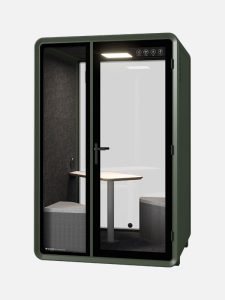
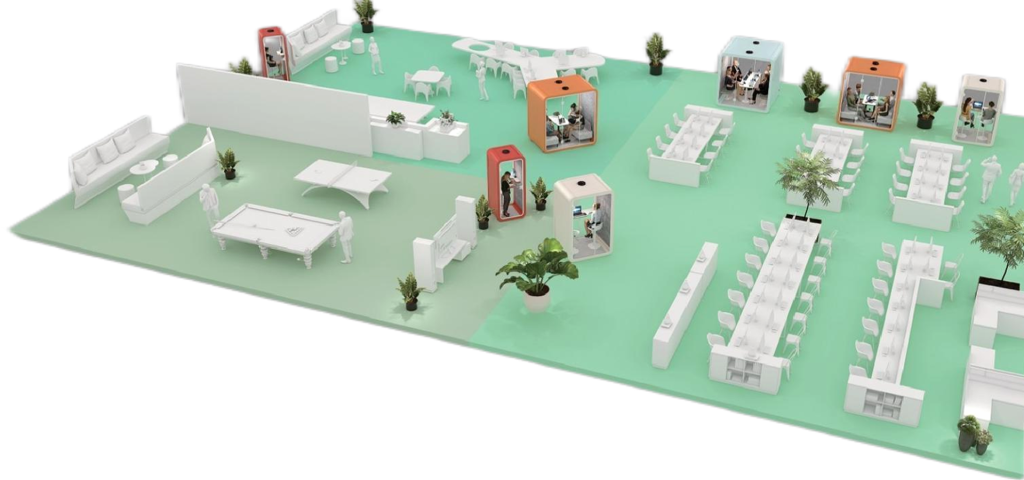
Functional Zoning: Design movement flow planning by separating high-traffic activity zones from focused work areas. Install soundproof pods/phone booths (2-3 units per 200 square meters). In open office environments where complete noise elimination proves challenging, companies can implement standalone soundproof cabins. These spaces enable extended calls, private matters, urgent tasks, meetings, and video conferences while maintaining acoustic isolation.
Typically designed as independent, fully soundproofed spaces, these office pods not only block external noise but also contain internal audio leakage. Office soundproof cabins have gained popularity in workspace planning and emerged as a growing entrepreneurial sector with significant revenue potential. Featuring comfortable Nordic-inspired designs, these acoustic pods now form an integral part of modern office transformations. They effectively address open-plan limitations while serving diverse employee needs, from confidential conversations to focused deep work sessions.
f: Management Measures
Provide Noise-Canceling Headphones: Supplying noise-cancelling headphones to employees not only reduces ambient noise but also enhances concentration. Additionally, employees wearing headphones naturally create a visual “do not disturb” signal to colleagues, effectively minimizing unnecessary interruptions. A University of California, Irvine study reveals that frequent workplace interruptions significantly increase stress levels, trigger frustration, and create time-wasting inefficiencies, with workers requiring an average of 23 minutes to fully regain focus after being disrupted.
6. Conclusion
While office noise may not show immediate impacts on productivity, chronic exposure leads to diminished focus, elevated psychological stress, and ultimately chronic inefficiency, with cumulative harm to both mental and physical health. Soundbox’s professional acoustic design integrates noise control with spatial planning to systematically enhance workplace well-being and operational efficiency. This strategic synergy not only elevates employee satisfaction but also delivers measurable ROI through sustained performance gains, positioning sound management as a vital long-term investment for forward-thinking organizations.