
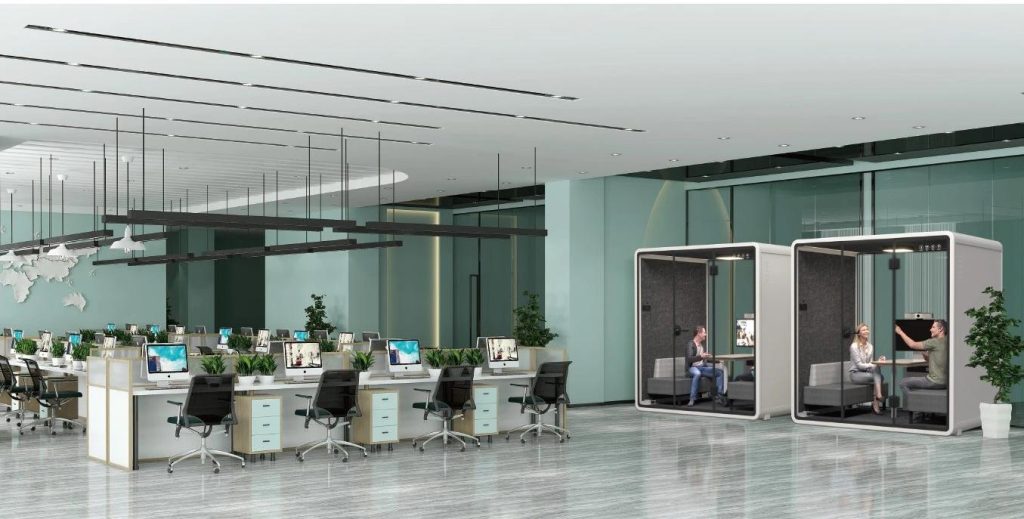
In the office workers at least 1/3 of the time in the office every day, the is good or bad, directly affecting the efficiency of the staff, as well as the state of mind.
According to a survey: in the enterprise, 78.9% of the employees have been “irritable” emotions, 59.4% of the people have felt “anxiety”, 38.6% of the people feel “depression “Only 5.8% of employees said they were not stressed.
One of the causes of these psychological problems is office noise.
More and more offices have excessive noise levels, and noise is slowly becoming a health killer.
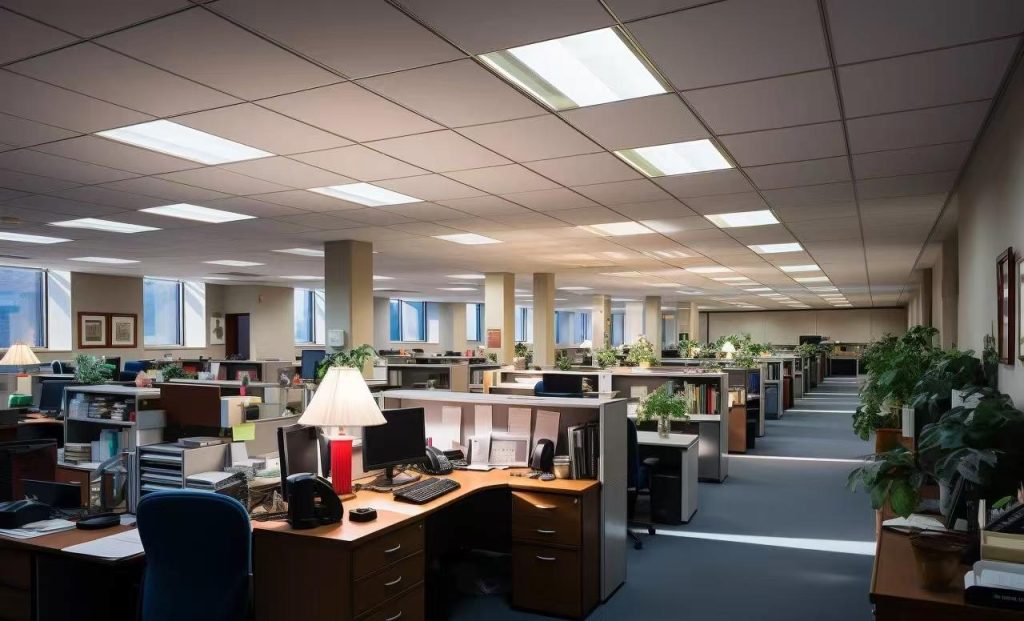
Most employees find it difficult to tolerate the physical and mental damage that a noisy office environment can do to them.
Therefore, a quiet office environment has become a demand for employees!
How does noise affect productivity?
Since the beginning of the 20th century, architects have noticed that the spacious and flexible characteristics of open-plan design can free office workers from closed boxes.
This discovery led to the widespread use of open plan offices until now more and more work environments will be renovated as open plan offices.
On the other hand, this approach has largely exacerbated the problem of environmental noise in offices. Studies have found that anytime noise in a space exceeds 70 decibels, it can be distracting.
As a result, employees suffer from noise and are unable to concentrate on their work, leading to lower productivity.
What kind of impact does noise cause?
According to the survey: every 1 decibel increase in noise, the incidence of high blood pressure increased by 3%. In 70 decibels to 90 decibels of noise to stay in 5 years, the risk of people suffering from high blood pressure will be 2.47 times higher.
Noise increases the incidence of hypertension, myocardial infarction, heart failure and stroke in humans.

In the daily office environment, the noise reaches 60 to 70 decibels. It is even as high as 75 to 120 decibels in industrial workshops.
Why does noise cause so much damage?
In fact, for the body, noise is a detriment.
Noise can adversely affect the hearing organs.
When it passes through the auditory system, noise damages hearing. Once it enters the brain, the secretion of various stress hormones, activation of inflammatory cells, and oxidative stress responses are altered. This process produces neurotoxicity, leading to neurodegeneration and impairing brain function.
Prolonged exposure to such a noise environment can lead to hearing impairment, neurasthenia, memory learning ability to decline, so that anxiety, anger, depression, exhaustion and other negative emotions proliferate.
According to medical experts experiments have proved that noise will not only increase the incidence of hypertension, myocardial infarction, heart failure and stroke and other diseases, but also irreversible damage to the auditory, nervous system.
Noise can adversely affect the visual organs.
Working in a high-noise environment, people often complain of eye pain, vision loss, blurred vision and other problems. This is because noise and vibration can cause a failure of the eye’s symmetrical balance response to moving objects. The reason for this is that the central nervous system is inhibited by noise stimulation.
In general, the greater the noise intensity, the worse the stability of visual acuity. The decrease in visual clarity is followed by a decrease in labor productivity.
Noise has adverse effects on other organs.
Recently, experts have put forward the theory of “environmental hormones”, pointing out that there are chemicals in the environment that can affect the endocrine function of the human body like hormones, and noise is one of them.
Noise is one of them. It can cause endocrine disruption in the human body, and prolonged noise pollution can cause male infertility, as well as miscarriage and fetal malformation in women.

If you find yourself surrounded by a large amount of noise, we must raise the awareness of prevention and take corresponding soundproofing measures. For example, carrying noise-canceling headphones, requiring the use of acoustic absorption products in corporate office spaces, or adding independent soundproof office space quiet pods.